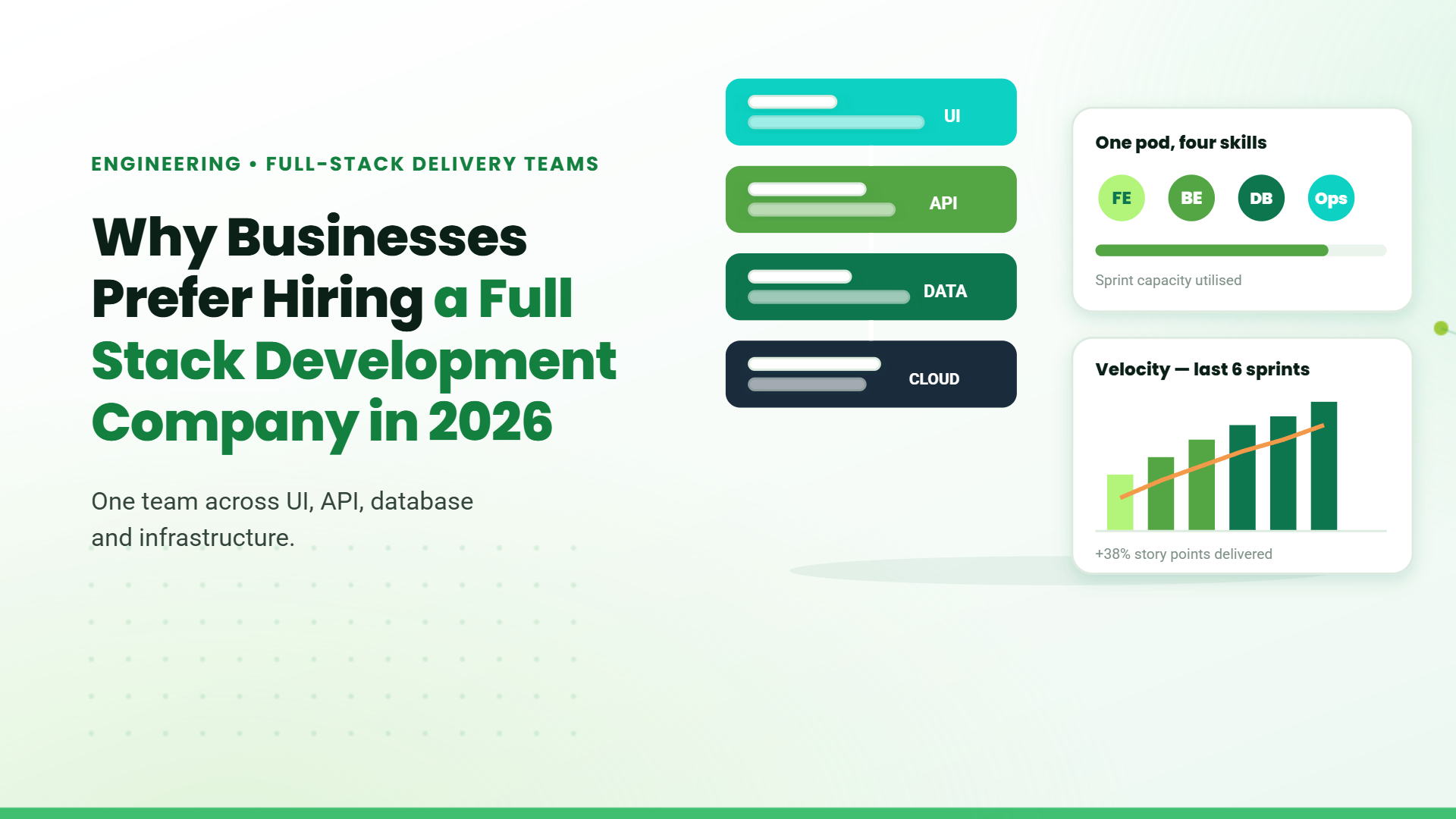
Why Businesses Prefer Hiring a Full Stack Development Company in 2026

Businesses are under pressure to build faster, launch quicker, and scale without increasing complexity. Managing separate frontend, backend, and infrastructure teams slows everything down. Costs go up, timelines stretch, and ownership becomes unclear.
This is where full-stack development becomes a more efficient approach. Instead of working in isolated teams, development moves into a single, connected workflow, which reduces dependencies and improves delivery speed.
However, most businesses don’t have the internal structure to manage this efficiently across hiring, coordination, and execution, so they prefer hiring a full-stack development company.
In this blog, we’ll break down what full-stack development is, why businesses are adopting this model, and how to choose the right full-stack company for your needs.

What Is a Full Stack Development?

Full-stack development is building both the frontend and backend of an application within a single workflow. Instead of splitting the user interface, business logic, and data across different teams, everything is handled together.
The same team works on the entire system, from what users see to how the application processes data and connects with other services. This includes frontend, backend, APIs, databases, and deployment.
A full-stack development company takes this approach and delivers it as a service, where one team owns the complete product from build to release.

Full Stack vs Traditional Development Model

Factor Full Stack Development Traditional Development
Team Structure Single team handles frontend, backend, and deployment Separate teams for frontend, backend, and infrastructure
Speed of Delivery Faster due to fewer dependencies and direct execution Slower due to cross-team coordination and handoffs
Cost Efficiency Lower cost with fewer teams and reduced overhead Higher cost due to multiple teams and longer timelines
Flexibility in Scaling Easier to scale with multi-skilled developers Complex scaling across multiple specialized teams
Risk and Dependencies Fewer dependencies, faster issue resolution High dependency between teams, delays are more likely
For businesses focused on speed, cost control, and simpler execution, the full stack model is the more practical choice.

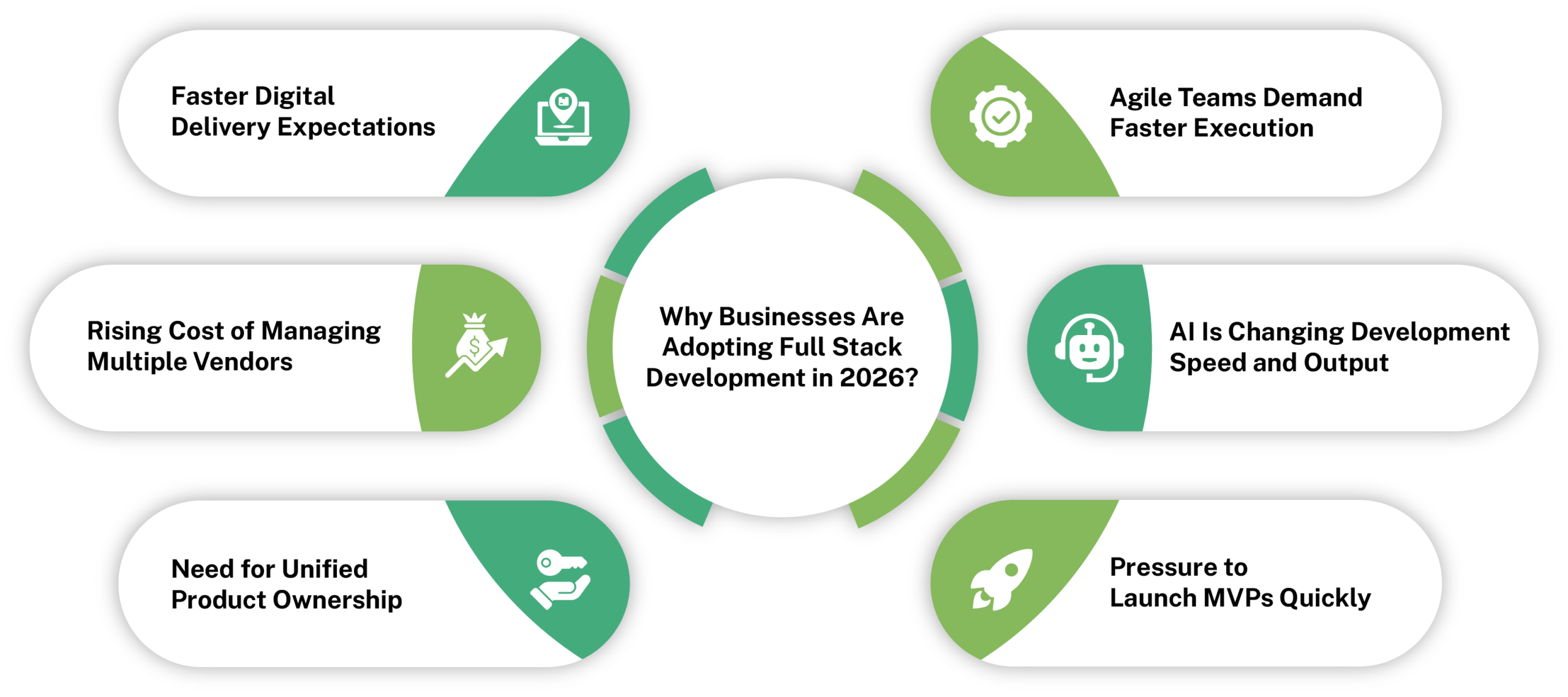
Why Businesses Are Adopting Full Stack Development in 2026?
Capabilities of a Full Stack Development Company

Frontend Development

Designs and builds user interfaces that are fast, responsive, and consistent across devices. Focus is on performance, accessibility, and a clean user experience. Works with modern frameworks to ensure smooth interactions and quick load times.

Backend Development

Develops the core logic that powers the application. Handles data processing, authentication, workflows, and system operations. Ensures the application is stable, secure, and capable of handling increasing user load.

API Development and System Integration

Builds APIs that allow different systems to communicate with each other. Integrates third-party services such as payment gateways, CRMs, and external tools. Ensures reliable data exchange and smooth system connectivity.

Database Architecture

Designs how data is structured, stored, and accessed. Chooses the right database type based on use case and scale. Focuses on data integrity, performance optimization, and efficient querying.

Cloud Infrastructure and Deployment

Sets up cloud environments to host and run applications. Manages servers, scaling, uptime, and resource allocation. Ensures applications are reliable and can handle traffic growth without performance issues.

DevOps and CI/CD Automation

Implements automated pipelines for building, testing, and deploying code. Reduces manual effort and speeds up release cycles. Helps teams deliver updates faster with fewer errors and consistent quality.

Common Business Applications of Full Stack Development
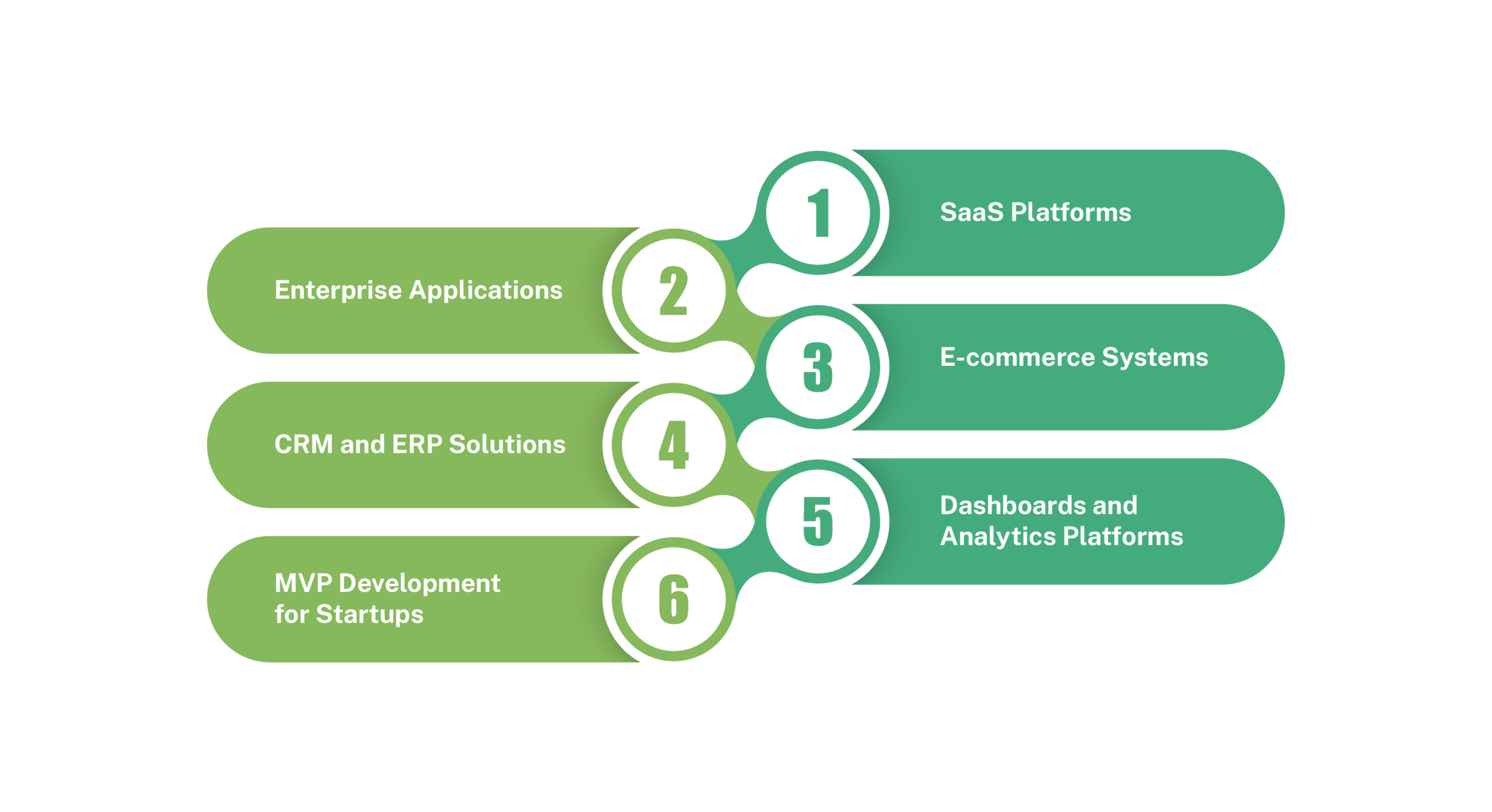
SaaS Platforms

SaaS platforms are built to serve multiple users through a subscription model. They require features like user authentication, billing systems, role-based access, and scalable backend services. Full-stack development ensures the user interface and backend systems work together to support continuous usage and regular updates.

Enterprise Applications

Enterprise applications support internal operations across departments such as HR, finance, and operations. These systems often involve complex workflows, large volumes of data, and strict security requirements. Full-stack development helps integrate these systems smoothly while maintaining stability at scale.

E-commerce Systems

E-commerce systems enable businesses to sell products online with features like catalog management, cart functionality, payments, and order tracking. These platforms need strong backend support for transactions and inventory, along with a fast and responsive frontend experience. Full-stack development connects these layers to ensure smooth and reliable operations.

CRM and ERP Solutions

CRM and ERP solutions manage customer data, sales processes, financial records, and operational workflows. These systems require structured data handling, automation, and integration with other business tools. Full-stack development brings all these components together into a single connected system.

Dashboards and Analytics Platforms

Dashboards and analytics platforms collect data from multiple sources and present it in a clear, usable format. They require backend processing for data handling and frontend layers for visualization. Full-stack development ensures accurate, real-time insights with a seamless user experience.

MVP Development for Startups

MVPs are built to launch a functional version of a product with core features. The focus is on speed, minimal complexity, and the ability to adapt based on user feedback. Full-stack development enables faster builds while keeping the product flexible for future growth.

Benefits of Hiring a Full Stack Development Company

  • Faster Development Cycles: A single team handles both frontend and backend, reducing dependencies and speeding up development, iterations, and releases.
  • Lower Total Development Cost: Working with one team reduces coordination overhead and the need for multiple specialists, helping control overall costs.
  • Single Team Ownership: A full-stack team takes responsibility for the entire product. This removes confusion around ownership and ensures issues are resolved faster.
  • Fewer Communication Gaps: With one team involved, communication is more direct, reducing delays and improving overall collaboration.
  • Better Stability and Performance: The same team builds and manages the full system, leading to fewer integration issues and more stable performance.
  • Easier Scalability: Systems are designed with growth in mind, making it easier to scale features, users, and infrastructure as needed.

How to Choose the Right Full Stack Development Company

Factor What to Look For
Technical Expertise Ability to work across frontend, backend, databases, and cloud, with the right stack choices for your use case.
Real Project Experience Experience building and managing live products with real users and scaling challenges.
End-to-End Capability Ownership from planning and development to deployment and ongoing improvements.
Communication Process Clear updates, structured workflows, and the ability to adapt quickly.
Cloud and DevOps Strength Experience with deployment, scaling, monitoring, and handling production environments.
Post-Launch Support Ongoing support for updates, fixes, and performance improvements.
The best full-stack development company is the one that can execute, adapt, and support your product as it grows.

Conclusion

Full-stack development has become a standard approach for building and managing modern applications. Instead of splitting work across multiple teams, it brings development into a more connected workflow that is easier to manage. As systems grow more complex and timelines become tighter, full-stack development services align better with how businesses need to deliver and evolve their products.

FAQs

1. What does a full-stack web development company do?

A full-stack web development company handles both frontend and backend development, along with databases, APIs, deployment, and maintenance, ensuring a complete end-to-end application development process.

2. Why should businesses choose a full-stack web development service?

A full-stack web development service helps businesses streamline development by using one team for the entire product, reducing delays, improving coordination, and ensuring faster delivery with better technical consistency.

3. What sets the best full-stack development company apart?

The best full-stack development company delivers consistent results across projects, handles complete development without gaps, and maintains clear ownership, making execution smoother and more reliable for growing business needs.

Share This Post

More To Explore