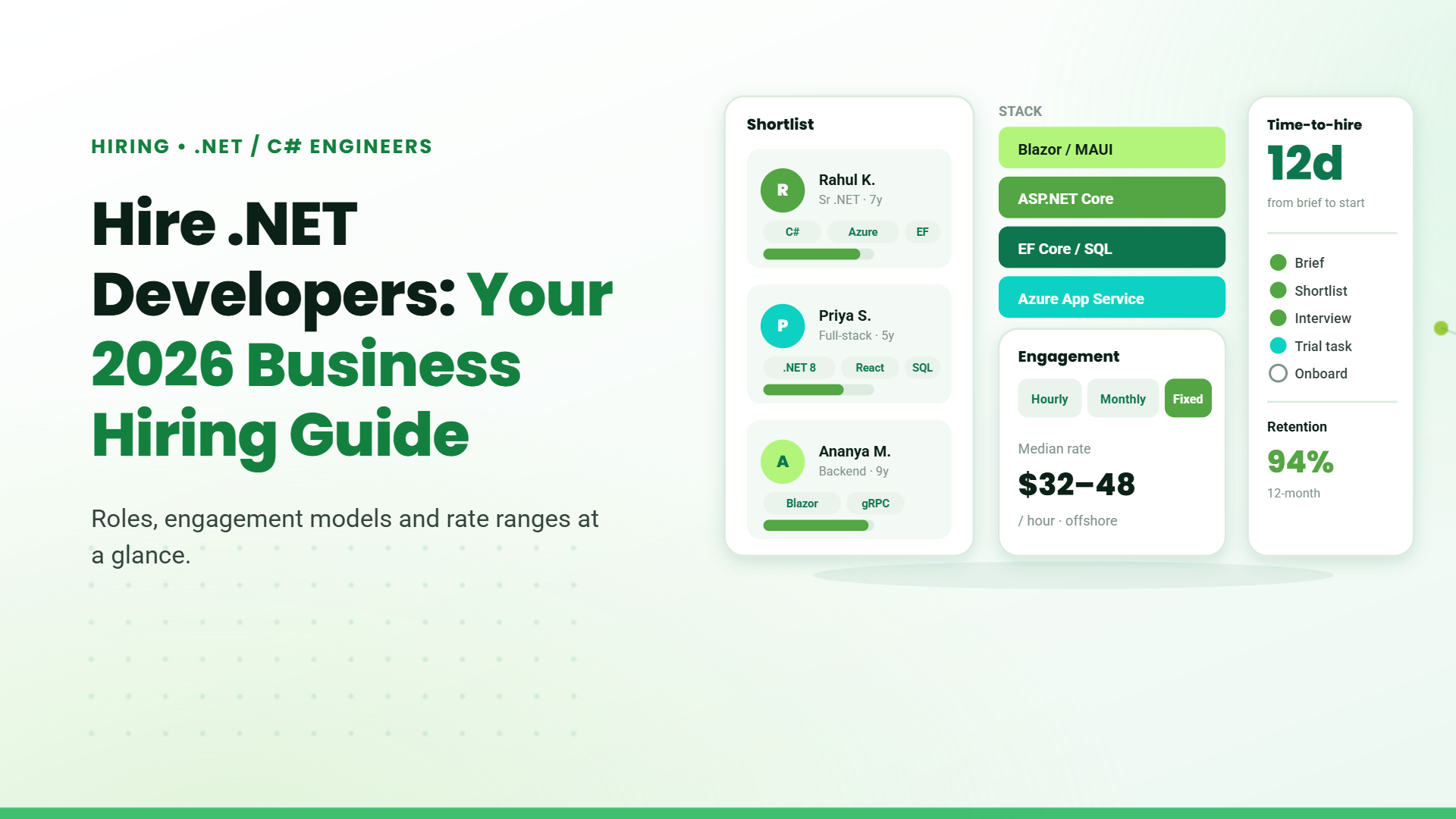
Hiring developers can be confusing. There is a lot of options, and it is easy to make a costly mistake. This guide is here to help.
Why .NET? And Why Now?
The AI Factor
Bottom line: .NET is a safe, modern, and forward-looking choice for business software.
What Can .NET Developers Build for You?
Web Applications and SaaS Platforms
Enterprise Systems and Business Automation
Cloud-Native and Microservices Architecture

In-House, Outsourced, or Dedicated Team - Which Is Right for You?
In-House Hiring
Offshore Outsourcing
Dedicated Developer Teams
If you are not sure which model to choose, start with a dedicated developer. It is flexible, focused, and usually the best value for growing businesses.
Skills to Look for in a .NET Developer
Technical Skills
- C#: the main programming language for .NET. The developer should know it well.
- NET Core: used to build web applications and APIs. Most .NET projects need this.
- Entity Framework Core: used to work with databases. Look for developers who understand how to write efficient queries.
- SQL Server or PostgreSQL: strong database skills are important for almost every project.
- REST API design: the developer should know how to build clean, well-documented APIs.
- Cloud platforms: Azure is the most common for .NET, but AWS and GCP are also used.
- Docker: modern apps run in containers. This is now a basic skill.
- CI/CD pipelines: the ability to set up automated testing and deployment saves time and reduces errors.
Soft Skills
- Clear communication: the developer should be able to explain their work in simple terms.
- Raises problems early: you want someone who tells you about issues right away, not at the last minute.
- Understands the business goal: a developer who knows why they are building something makes better decisions.
- Works well in agile teams: comfort with sprints, daily check-ins, and team reviews is a good sign.
- Keeps learning: technology changes. Developers who stay up to date are more valuable over time.
Note: A good C# developer is not always a good .NET developer. Look for real framework experience, cloud knowledge, and communication skills.
Architecture Knowledge
- Microservices: the ability to break a large system into smaller, independent parts that are easier to maintain and scale.
- Clean Architecture and SOLID principles: these help developers write code that is easy to update and test over time.
- Domain-Driven Design (DDD): a way of organising complex business logic so it stays manageable as the product grows.
- Event-driven design: useful for systems that need to handle a lot of activity at once, such as messaging or notifications.
- Database design: a good developer does not just write queries. They design databases that work well as data grows.
Security Best Practices
- NET Core Identity, OAuth2, and OpenID Connect: standard tools for login and user access control.
- JWT tokens: proper handling of authentication tokens, including expiry and refresh.
- Input validation and parameterized queries : basic practices that prevent common attacks like SQL injection.
- HTTPS and CORS settings: required for any app that is live on the internet.
- Secrets management: passwords and keys should never be stored in code. Azure Key Vault or environment variables should be used instead.
- OWASP Top 10: awareness of the most common security vulnerabilities is a basic expectation.
For healthcare and finance projects, ask specifically about HIPAA, PCI-DSS, or GDPR experience. Security compliance is not optional in regulated industries.
How Much Does It Cost to Hire .NET Developers in 2026?

Other Costs to Keep in Mind
- Onboarding time: it takes time for any developer to learn your codebase and start being productive
- Communication delays: working across time zones adds overhead, especially if there are language barriers
- Technical debt: a cheaper developer who writes poor code can cost much more to fix later
- Tools and access: software licenses, environments, and security setup all have a cost
The cheapest option is rarely the best value. Focus on quality, communication skills, and relevant experience.

How to Hire the Right .NET Developer (Step-by-Step Process)
Step 1: Define Project Scope
- What does the software need to do?
- What does success look like in 3 to 6 months?
- What technology is already in place, if any?
- Who will the developer work with?
- What is the timeline and rough budget?
Step 2: Choose a Hiring Model
Your hiring model affects cost, speed, and how much control you have. Here is a simple guide:
- Freelancer: good for short tasks like a single feature or a bug fix. Easy to start, but less reliable for long project.
- Dedicated developer: works only on your project, managed by you, employed by a vendor. Good balance of focus and cost.
- Outsourced team: a company delivers the project end-to-end. Good for well-defined projects where you want less day-to-day involvement.
- In-house hire: a full-time employee. Best for long-term, core development work if you have the budget.
Not sure? Start with a dedicated developer. It is flexible, focused, and usually the right choice for growing businesses.
Step 3: Technical Interview Checklist
- Tell me about a system you designed. What decisions did you make and why?
- How would you build an API that is used by both a web app and a mobile app?
- Tell me about a time you had to improve someone else’s code. How did you handle it?
- How do you manage user login and permissions in a web application?
- What do you do when a database query is running slowly?
- How do you set up automated testing and deployment for a .NET project?
- Tell me about a time something broke in production. How did you fix it?
Listen for clear thinking and honest answers. If a candidate cannot explain their work in simple terms, they may struggle to communicate on your team.
Step 4: Coding Test Framework
- Keep it short – 2 to 4 hours is enough. Longer tests push away good candidates who have other commitments.
- Pay for it – a small payment shows respect and attracts serious applicants.
- Make it relevant – use a task similar to real work in your project. Avoid abstract puzzles.
- Review the full submission – look at code structure, naming, error handling, and tests. These reveal how the person thinks.
- Do a short debrief call — ask them to walk you through their solution. This shows communication skills and technical reasoning.
The goal is to see how they work, not to trick them. Clean, simple, well-tested code on a small task is a very good sign.
Step 5: Trial Period Strategy
- Length: 2 to 4 weeks for a freelancer or dedicated developer. Longer for a full team.
- Task: Pick something real but not critical. A contained feature or improvement works well.
- Success criteria: Decide in advance what good looks like code quality, communication, and meeting the deadline.
- Check-ins: Ask for a short daily update. This shows how they communicate before any pressure builds up.
- Decision: At the end of the trial, make a clear yes or no decision. Do not let it drag on with no conclusion.
Industries That Use .NET the Most
Finance and Banking
Healthcare
E-Commerce and SaaS
Common Hiring Mistakes to Avoid
- Hiring on price alone – a developer charging low rates but delivering poor code will cost you more in fixes and delays
- Skipping the architecture question – always ask how they would design your system, not just whether they know specific tools
- Ignoring cloud and DevOps skills – modern .NET development depends on cloud platforms and automated deployment
- No clear goals or success criteria – if you do not define what good looks like, you will not know when you have it
- Poor onboarding – even great developers need time to learn your codebase, your team, and your processes
AI and .NET Development in 2026
Quick Takeaways
- .NET is a stable, cross-platform technology that works well for enterprise and SaaS products
- A dedicated developer team is usually the best balance of quality, focus, and cost
- Rates vary by region – Eastern Europe and Asia offer good quality at lower cost
- Do not hire based on price alone – communication and architecture skills matter more
- Always run a short paid trial before a long commitment
- Ask candidates if they use AI tools – it is now a useful signal
Table of Contents
Talk to our Microsoft Expert Consultant
Conclusion
Share this article