Introduction
Dynamics 365 FO Retail and Commerce for Real-World Retail Operations
Retail and commerce operations are rarely simple. A typical retailer today runs physical stores, one or more e-commerce sites, marketplaces, and a mix of central and local warehouses. Stock moves quickly, customers expect accurate promises, and finance teams need clean data every day, not just at month-end.
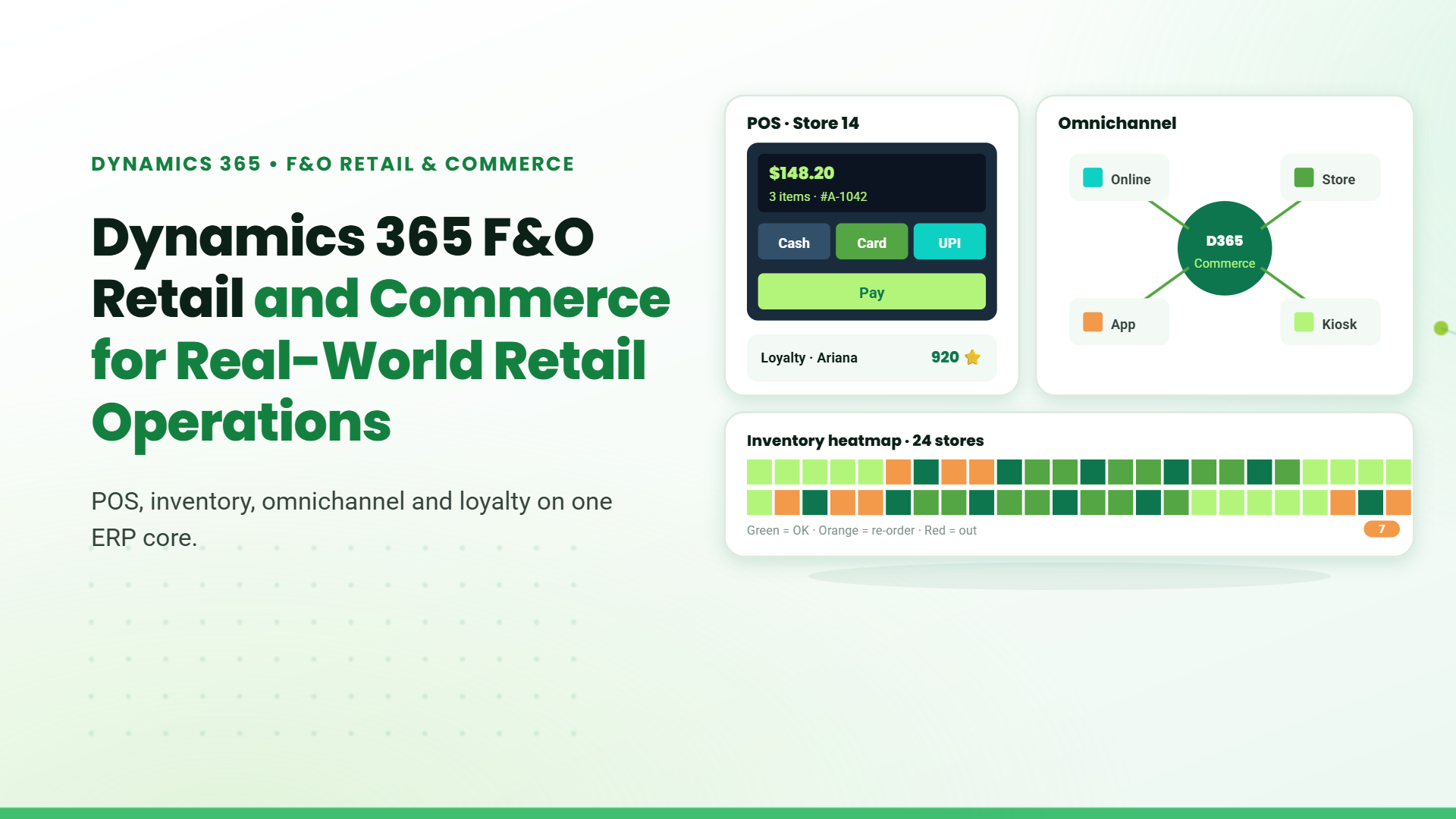
This is where Dynamics 365 FO Retail and Commerce often enters the discussion. Dynamics 365 Finance and Operations (FO) handles finance, supply chain, and core operations. Dynamics 365 Commerce adds store POS, online channels, and customer journeys on top of the same platform. Together they give retailers one connected system across front office and back office.
Software alone does not deliver results though. From a solution delivery company view, our work is to turn this platform into real business gains. We link the product to your business model, your teams, and your data, so your staff can run better stores, smarter promotions, and cleaner financials every day.
What Dynamics 365 FO Retail and Commerce Really Solves for Retailers
When retailers talk to us about Dynamics 365 FO and Commerce, they rarely start with features. They describe problems. Stock figures that nobody trusts. Prices that change in e-commerce but lag at the register. Finance teams that spend nights in Excel just to close the month.
Dynamics 365 FO and Commerce target these pains by bringing sales, inventory, and finance into one model. Stores, online channels, and warehouses share the same product, customer, and transaction data. That is where the real value sits.
The result is not a shiny new system, but very concrete outcomes. Store managers see real stock on hand. Web orders flow into the same order pool as store sales. Finance teams see margin by channel and product in near real time. Retail leaders gain one version of the truth and a platform that can grow with new formats and markets.
Connecting stores, e-commerce, and back office in one system
Dynamics 365 FO manages finance, purchasing, inventory, and fulfillment. Dynamics 365 Commerce adds store POS, call centers, and online storefronts, all on a shared foundation. From a retailer view, this matters because product, price, and customer data live in one place.
Think about a simple price change. In many retailers, the pricing team updates one system for stores, another system for e-commerce, and maybe a third for marketplaces. Someone forgets a step, or a file fails, and customers see three different prices for the same item.
In a well designed Dynamics 365 FO Retail and Commerce solution, pricing is set once in the head office and then pushed to stores and online channels from the same source. When the price changes, it changes everywhere at the same time.
The same logic applies to stock. If a customer buys the last item in a store, that sale updates available stock for online orders. If a warehouse receives a shipment, store replenishment, e-commerce promise dates, and finance postings all pick up that receipt from the same data.
Fixing stock, pricing, and promotion pain points
Most retail issues we see fall into three groups: wrong stock, wrong price, and promotions that are too hard to run. Dynamics 365 FO and Commerce can address each of these, but the design choices matter.
A delivery partner helps retailers set up:
- Item and variant structure that matches how buyers, merchandisers, and store staff think. For example, color and size variants that roll up to clear reporting and simple POS views.
- Pricing rules that support base prices, customer groups, and channel-specific rules without forcing teams to maintain endless price lists.
- Promotion logic that is powerful, yet still clear to store and marketing users, such as mix-and-match, buy X get Y, or spend thresholds.
The key is to design the item hierarchy, pricing, and promotion settings so that business users can manage them day to day. Our role as a solution delivery company is to set up templates, examples, and guardrails that reduce errors, so your teams are not afraid to change prices or launch a weekend promotion.
Giving finance and operations leaders clear and timely data
For CFOs and operations leaders, Dynamics 365 FO shines when sales, inventory, and finance sit in one structure. Every sale, whether in-store or online, creates consistent accounting entries and updates stock and margin.
This supports:
- Faster period close, because less data lands in spreadsheets outside the system.
- Clear margin view by channel, category, or even item, without complex reconciliation.
- Easier audits, since transactions, inventory moves, and postings all trace back to the same source.

How a Solution Delivery Company Designs and Delivers D365 FO Retail and Commerce
Success with Dynamics 365 FO Retail and Commerce does not start with screens. It starts with how your retail business works today and how you want it to work in three years. Our job as a delivery partner is to connect that picture to what the product does well, and to be honest about where it may not fit.
We follow a structured approach from early workshops through to go-live and support, always tying back to clear business outcomes.
Starting with business goals, not features
In discovery, we focus on questions such as:
- What profit and growth targets do you have for each channel?
- Where do store staff and head office teams lose time today?
- How do you plan to expand, for example, new markets, new formats, or more marketplaces?
We then map these goals and pain points to Dynamics 365 FO and Commerce capabilities. If you want tighter stock control and lower markdowns, we look at replenishment, allocation, and pricing. If omnichannel fulfillment is a core goal, we look closely at order orchestration and store operations
Sometimes we find that a standard feature does not fit a key part of your model. In that case, we highlight it early, so you can decide whether to adjust the process or invest in an extension.
Why D365 FO Gives Retailers a Strategic Edge
End-to-End Operational Clarity:
Retailers gain a transparent view of everything from product flow to financial performance. This clarity removes the blind spots that often slow down retail organisations.
Better Customer Experience:
Unified systems deliver consistency – accurate inventory, reliable fulfilment, aligned pricing, and frictionless service. For customers, this translates into trust and loyalty.
Confident Growth and Expansion:
Retailers are able to scale stores, channels, and markets without destabilizing operations. The platform’s architecture supports expansion rather than constraining it.
Table of Contents
Talk to our Microsoft Expert Consultant
Conclusion
Dynamics 365 Finance & Operations provides a robust operational backbone for retailers navigating the complexity of modern commerce. By unifying finance, supply chain, merchandising, store operations, and eCommerce into one platform, D365 FO empowers retailers to operate with clarity, precision, and speed. In a market where every detail influences profitability, D365 FO offers the structural advantage needed to stay competitive and grow confidently.
Share this article

About the Author
Chandru is a technology professional experienced in business automation, Microsoft solutions, and digital transformation. Through practical insights, [he/she/they] helps businesses understand emerging technologies and achieve meaningful outcomes.